
Driving Innovation, Growth, and National Renewal
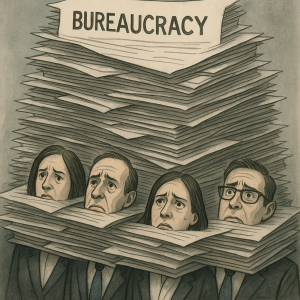
Britain stands at a crossroads. For too long, our potential has been throttled by bureaucracy, short-termism, and a financial system that confuses compliance with competence. We have the ingenuity, the talent, and the tools — yet the arteries of enterprise are clogged with red tape, risk-aversion, and systems designed by people who have never built anything real.
The truth is simple: Britain doesn’t lack ability. It lacks permission — the permission to build, to invent, to trade, and to dream on a national scale once again.
This series — Rebuilding Britain’s Business Ecosystem — explores how we can unleash that potential and power a new industrial and entrepreneurial renaissance for the 21st century.
Our Vision
To create an economy where ideas can grow as easily as they are conceived — supported by a financial system that serves, not suffocates, the people who drive innovation.
We believe in:
-
Unblocking the rivers of finance — ensuring access to fair capital for start-ups, SMEs, and innovators.
-
Restoring trust in enterprise — replacing opaque decision-making with transparent, accountable systems.
-
Reforming education and STEM pathways — equipping future generations with the practical and scientific skills Britain once led the world in.
-
Rebuilding industrial capacity — encouraging domestic production, manufacturing, and sustainable innovation.
-
Empowering entrepreneurship — making it simple to start, grow, and scale businesses across all regions of the UK.
The Challenge Ahead
Britain’s economy was once the beating heart of global innovation.
The Industrial Revolution began here because we dared to think differently and act decisively. The UK dominated the global industrial market for approximately a century, from the late 18th century until around the 1870s, at which point its dominance began to be challenged by other industrialising nations and we failed to adapt to a changing world, resting on our laurels.
However, today, that same spirit still exists — but it’s trapped beneath layers of digital obstruction, institutional fear, and political drift.
Britains economy was once the beating heart of the entire world, yes, others had industry, we were not alone, but the sheer scale of ours was on another level entirely, and this fueled innovation in science, engineering, medicine and technology on an industrial scale that truly changed the entire world and helped to make the world we have today.
Here are a few exmaples of the roughly 25,000 that exist which changed the world as we know it
Engineering & Industrial
-
The Steam Engine (James Watt, 1765–1776) – cornerstone of industrialisation; turned coal and water into the power that built the modern world.
-
The Iron Bridge (Abraham Darby III, 1779) – world’s first cast-iron bridge; symbol of applied ingenuity and confidence in new materials.
-
Railways (George & Robert Stephenson, 1825 onwards) – knit the country together, created mass mobility, and transformed commerce.
Science & Medicine
-
Smallpox Vaccination (Edward Jenner, 1796) – eradicated one of history’s worst diseases and laid the foundation of modern immunology.
-
Electromagnetism & Electric Motors (Michael Faraday, 1820s–1830s) – the physics that powers everything from generators to computers.
-
Germ Theory & Antiseptics (Joseph Lister, 1860s) – revolutionised surgery and medical hygiene, saving millions of lives.
Technology & Communication
-
The Telegraph (Cooke & Wheatstone, 1837) – the first digital communication network, decades before the telephone.
-
Photography (Fox Talbot, 1830s–1840s) – captured reality for the first time and gave rise to modern imaging, media, and documentation.
Between the 18th and mid-19th centuries, Britain became the workshop of the world — a small island whose inventions reshaped every aspect of human life. Watt’s steam engine, Stephenson’s railways, Faraday’s electricity, Jenner’s vaccination, Lister’s antiseptics and Cooke & Wheatstone’s telegraph all came from one nation that valued ingenuity, education, and persistence over bureaucracy.
But our tradition of innovation began even earlier — with Charles Babbage, whose Analytical Engine laid the theoretical foundations of modern computing, and Ada Lovelace, who wrote the first algorithm and grasped, a century before anyone else, that a machine could manipulate symbols as well as numbers. Their partnership defined the intellectual birth of the information age.
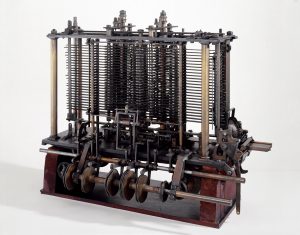
This was the first fully-automatic calculating machine. British computing pioneer Charles Babbage (1791-1871) first conceived the idea of an advanced calculating machine to calculate and print mathematical tables in 1812. This machine, conceived by Babbage in 1834, was designed to evaluate any mathematical formula and to have even higher powers of analysis than his original Difference engine of the 1820s. Only part of the machine was completed before his death in 1871. This is a portion of the mill with a printing mechanism. Babbage was also a reformer, mathematician, philosopher, inventor and political economist.
That same spirit endured into the 20th century. The creation of the National Grid in the 1930s, and its integration with the communications, radar, and command systems of the Second World War, produced a layered, decentralised network that kept Britain alive during the Battle of Britain. Power, radar, observers, anti-aircraft command, fighter control, and intelligence were all interlinked — the first true internet of systems. While Germany sought to cripple us by bombing individual targets, Britain’s engineers had already built resilience into the nation’s nervous system.
That legacy — the marriage of imagination, engineering discipline, and national coordination — is what we must rediscover. When Britain aligned science, industry, and purpose, it didn’t just compete; it changed the world.
We cannot afford another lost generation of talent.
To build a strong, sovereign, and prosperous Britain, we must reconnect government policy, education, and finance to the real world of creation, invention, and enterprise.
There is life in this old dog yet — but only if we remove the shackles that biond and let it off its leash and allow it to run free.
Explore the Series
Each article below examines a different strand of the ecosystem we must rebuild — from finance and banking reform to technological innovation, SME support, and national industrial strategy.
-
Getting Business Moving Again
A look at how Britain’s financial system has paralysed small enterprise — and what must change to free it. -
When Chatbots Replace Common Sense
How automation and bureaucratic ignorance are strangling business creation before it begins.
(More articles will be added as the series grows.)
Join the Conversation
We are inviting entrepreneurs, innovators, engineers, educators, and business leaders and investers at all levels to contribute with their perspectives and and experience on this critical topic as it has impacts them in their career and how they see it impacting them in the future and what they feel needs to change to make life easier for business to make growth, innovation and investment easier without having negative impacts on employment relations.
If you have faced the same challenges — or found solutions that work — your voice belongs here.
Together we can rebuild an economy that works for those who build it, not just those who trade it.
The more voices that speak up, the clearer the picture becomes and the clearer the message that evolves….please do consider taking part.
To contribute:
Send your article or expression of interest to contribute@britishdemocracy.co.uk, or connect with us via LinkedIn.
The British Democratic Alliance — Turning Frustration into Reform
This is more than a commentary series — it’s the start of a national blueprint for renewal.
We intend to spark the biggest transformation in Britain’s economic story since the Industrial Revolution — grounded in fairness, intelligence, and ambition.
Britain’s economy can thrive again — if we rebuild a business ecosystem that rewards innovation, restores enterprise, and unblocks the flow of finance, skills, and ambition. Discover the British Democratic Alliance plan for national renewal.
#SME policy, #business banking, #industrial strategy, #economic growth, #STEM, #finance reform, #BDA,#BritishDemocraticAlliance
© British Democratic Alliance 2025