
Understanding the British Isles Geography, History, and Political Realities
“October extinguished itself in a rush of howling winds and driving rain and November arrived, cold as frozen iron, with hard frosts every morning and icy drafts that bit at exposed hands and faces.” Harry Potter: J.K. Rowling
“In the Bible, God made it rain for forty days and forty nights; and that was still the best summer we had!”: Rhod Gilbert, Welsh Comedian
In the British Isles, we are many things: diverse in heritage, language, and regional pride: but one universal element of our shared culture is the weather.
Perched on the north-western fringe of Europe, this archipelago of islands are thrust into the path of the Atlantic’s temperamental moods. With no mountains or continental buffer to shield us, we endure whatever nature hurls our way. (Allan et al., 2008).
Whether Welsh, Scottish, Irish or English, we face the climate with quiet resolve.
We joke, we complain, we mutter, we endure. Talking about the weather is not merely small talk, It’s a national ritual.
These islands are neither the coldest nor the wettest in Europe, but they are reliably grey, persistently damp, and often wind-blown.
Perhaps weather alone is not enough to define what it means to be a Briton. But as a symbol of our endurance, humour, and stoicism – it’s not a bad place to begin.
There are some commentators telling us that including the Island of Ireland in our icon is wrong because Ireland is not British, now politically that is, of course 100% correct, and rightly so, but we are using the term British Isles in a geographical sense, not political., and please, if you are a proud Irish, do not take offence, we most certianly mean none.
However, to avoid confusion, to avoid people becoming upset with an appearance of “colonialism”, we thought it would be wise to clarify matters, so please, do not take offence, we do not support colonialism or annexation of any place, lets leave the mistake of history in the history books and lok forward to a collaborative and prosperous future.
Introduction
Few terms in modern discourse provoke as much confusion and misinterpretation as “the British Isles.” Misunderstood by many and frequently weaponised by online polemicists, this geographically rooted term is often wrongly equated with political identity, specifically with England or the United Kingdom. Here we seek to clarify the term’s proper geographical usage, explain the differences between England, Great Britain, the United Kingdom, and, most importantly, the British Isles, and explore the political history that has contributed to today’s fractured understanding.
To clarify, the red boundary shown in Map 1 outlines the internationally accepted geographical and geological extent of the British Isles, including all landmasses and sea shelf territories typically considered part of this archipelago.
What Are the British Isles?
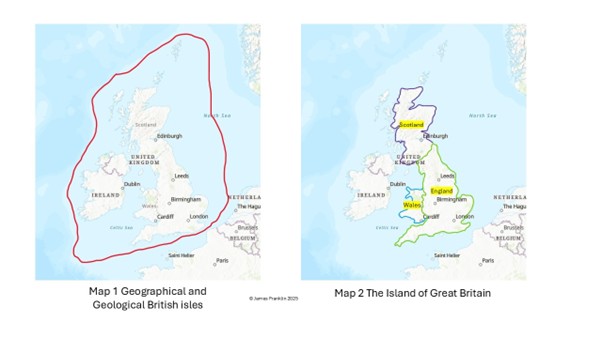

The “British Isles” is a geographical term, not a political one. It refers to an archipelago grouping of over 6,000 islands off the north-western coast of continental Europe.
To clarify this lets specify that the British Isles geopolitically consists of
~ 302, 500 km2 of land Area
~173,000km2 of Territorial waters (This is both the UK and Ireland)
~1.18 million km2 Exclusive Economic Zone
If we define the British Isles as the total landmass plus immediate regional EEZ waters (around the islands and the Irish Sea, Celtic Sea, parts of the North Sea and Atlantic shelf), the full area is:
Total geographical entity: ~1,482,500 km2
However, let’s restrict ourselves, for this discussion, to the land areas to ensure that we have made clear our stance on the use of the British Isles descriptor.
This includes:
Great Britain (the largest island, comprising England [58.9%], Scotland [34%], and Wales [7.1%]) but excluding all Islands in river estuaries and offshore.
Ireland (including both the Republic of Ireland and Northern Ireland)
Isle of Man
Hebrides, Orkney, and Shetland Islands
Anglesey,
Isles of Scilly,
other minor outlying islands
Not included:
The Channel Islands (Jersey, Guernsey, etc.) are not geographically part of the British Isles, not only because they are located closer to France, but they are geographically part of continental Europe. However, they are self-governing Crown Protectorates and thus, indirectly, part of the UK politically.
British Overseas Territories.
Despite its ubiquity in atlases and academic writing, the term “British Isles” is controversial, especially in the Republic of Ireland, due to the perceived colonial overtones of the word “British.”
Sadly, the actions of numerous English Governments and Generals have left an indelible and unsavoury perception in the soul of the Irish, and quite rightly and understandably so.
Alternative terms like “Britain and Ireland” are often preferred in diplomatic or politically neutral contexts, and if speaking politically, it is currently correct to use this term rather than lumping the Irish in with the English, which they are not happy about.
The island of Great Britain is the 9th largest on the planet, but an island, nonetheless. The Greek explorer Pytheas, during his travels around 325 BCE, encountered and recorded the name “Prettanike” or “Brettaniai” for the islands off the coast of Europe. This name is believed to be derived from the Celtic word “Pretani” or “Britanni,” which referred to the inhabitants of the islands. The Romans later adopted and adapted the name, using “Britannia” to refer to the island during their rule, starting in the 1st century BC. While the Romans used “Britannia,” the name evolved over time and across different languages. The name “Great Britain” itself emerged later, distinguishing the island from “Little Britain,” referring to Brittany in France, although some sources suggest that the Greeks differentiated the islands into Great Britain for the main island, and Little Britain for the smaller island that we now call Ireland.
Geology vs Geography
Geographically and geologically, these islands form a single archipelago. However, some islands have geological origins that differ significantly:
The Shetland Islands are geologically distinct and more closely aligned with formations near the Faroe Islands.
The English Channel was formed approximately 8,000 years ago, when rising sea levels, and a catastrophic flood event, at the end of the last Ice Age submerged the land bridge known as Dogger land, physically separating Britain from mainland Europe.
This geological history has contributed to Britain’s island identity, but it does not define political boundaries.
England, Great Britain, and the UK – Clarifying the Terms
England – One country located on the island of Great Britain. It is synonymous with the UK, but it is NOT the UK, just one part of it.
Great Britain – The island comprising England, Scotland, and Wales – excluding all estuarine and offshore Islands.
The United Kingdom (UK): Short for The United Kingdoms of Great Britain, Wales and Northern Ireland, includes:
- England
- Scotland
- Wales
- Northern Ireland (on the island of Ireland)
Political convenience often includes all overseas territories such as the Channel Islands, Isle of Man and all other British Overseas Territories.
To equate “England” with “the UK” is both factually wrong and politically charged, this should be avoided at all times, it is often seen as erasing the identities and autonomy of the other nations within the UK which is both divisive and insulting.
The Emergence of the United Kingdom
The UK as a political entity has evolved over time:
1603 – Union of the Crowns – James VI of Scotland inherited the English throne, becoming James I of England. The crowns were united, but the parliaments and legal systems remained separate.
1707 – Acts of Union united the Parliaments of England and Scotland to form the Kingdom of Great Britain. This was partly driven by economic incentives and dynastic concerns. Ironically, many assume the English Parliament absorbed the others, in truth, it ceased to exist, both it and the Scottish Parliament were dissolved.
1801 – The union was extended to include Ireland, forming the United Kingdom of Great Britain and Ireland.
1922 – Most of Ireland left the UK to become what is now the Republic of Ireland, leading to the modern configuration – the United Kingdoms of Great Britain, Wales and Northern Ireland.
This means that the UK is a political union, not a geographic one.
Devolution and Political Identity
Since the late 1990s, the UK Government has created the devolved governments.
- Scotland has its own Parliament
- Wales has the Senedd
- Northern Ireland has the Stormont Assembly
England, paradoxically, has no devolved parliament. English affairs are handled by the UK Parliament, which also includes MPs from Scotland, Wales, and Northern Ireland. This creates a strange situation where England has less national political autonomy than the others, despite being the largest constituent part.
Scottish, Irish and Welsh MPs are able to vote in debates about matters that only impact England, but the English MPs are barred from taking part in debates and votes in the devolved parliaments, distorting democracy!
The EU is Not Europe, and the UK is Not the British Isles
Just as it is absurd to equate the European Union with the whole of Continental Europe, it is equally mistaken to conflate the United Kingdom with the entire British Isles. One is a political union; the other is a geographical space.
The Republic of Ireland is part of the British Isles, geographically, but it is a rightly proudly independent nation state that is not part of the UK or under British governance.
These distinctions matter because confusion over terms leads to misinformed opinions, toxic debates, and nationalistic distortions. It is possible to describe Ireland as part of the British Isles geographically while still respecting its political and cultural independence and sovereignty, how you describe it depends on the context of the conversation and the message you intend to convey.
The Term “Briton” – Origins and Misuse
The term Briton has historical and cultural roots that predate the United Kingdom by at least 1500 years. Originally, it referred to the Celtic speaking inhabitants of the British Isles prior to, and certainly, during Roman times, known as the Brittonic peoples. Today, it is often used more loosely to refer to people from the United Kingdom or from Britain more broadly, but this is inaccurate. (Killingray, 2008)
Historically speaking.
The Irish, Welsh, Cornish, and Scottish Highlanders and Islanders are among the most direct descendants of the ancient Britons.
Much of England, particularly the southeast and east, was heavily influenced by Anglo-Saxon, Norse, and Roman migration and settlement, creating a different cultural and genetic blend.
To object to being called a “Briton” on the basis of political grievance is therefore misguided. It is a historical and geographic identity, not a contemporary nationalist label. In fact, those who are most upset by the term are often the least aware of its historical context.
Many modern Scots, Irish, and Welsh who vocally reject the term “British” or “Briton” are often more authentically descended from the ancient Brittonic peoples than the majority English people are.
Meanwhile, the average person from southeast England, especially in counties like Kent, Essex, Norfolk, and Sussex, are more likely to descend from Anglo-Saxon, Norse, Norman French, and later European immigrants than from the original Celtic Britons. To clarify.
Welsh – Often considered the most direct descendants of the original Britons. Welsh is a direct continuation of the ancient Brittonic language.
Scottish Highlanders and Islanders – Though influenced by Gaelic Irish culture, they retained many ancient Brittonic and Pictish traits.
Cornish – Closely related to the Welsh (in fact, Cornwall and Devon where once called South Wales), their language is a surviving Brittonic tongue, and their cultural lineage is undeniably Brittonic.
Irish – While technically Goidelic Celts (not Brittonic), the Irish are ethnically and culturally distinct from Germanic England and share pre-Anglo cultural continuity.
English (especially in the southeast) – Heavily mixed with Anglo-Saxon, Danish Viking, and Norman elements. By the 11th century, the majority of English elites were French speaking. The Brittonic language had almost entirely died out in England by the 9th century.
The Brittonic languages (Welsh, Cornish, and the now-extinct Cumbric) survived outside of England. The term “Briton” originally didn’t even refer to what we now call “English” people at all, it referred to the pre-Saxon Celtic peoples. (Goodacre et al., 2005).
Many who proudly call themselves “British” today (especially from parts of England) are, ironically, genetically and culturally less Briton than those who object to the term.
Those who refuse the label (in Wales, Scotland, and Ireland) are often the closest living cultural heirs to the actual ancient Britons.
To summarise, “Briton” captures a broader, more inclusive sense of identity that embraces all peoples of the British Isles, reflecting their rich and diverse cultural heritages. In contrast, “British” pertains specifically to the legal identity associated with citizenship in the UK, which, while inclusive on a political level, may not fully encompass the historical and cultural complexities found among the peoples identified as Britons.
Yet, nationalism and modern politics warp these definitions into absurdities. It’s a perfect example of how words change meaning, and how history gets selectively reinterpreted.
Final comments.
In an age where misinformation spreads faster than facts, clarity matters. Understanding the difference between the British Isles, Great Britain, England, and the United Kingdom is not just pedantic wordplay, it is vital to informed debate, respectful discourse, and historical literacy.
If we want better conversations about who we are, where we live, and how we relate to our neighbours, it must begin with knowing where the borders really lie, not just on the ground, but in the mind.
Geography does not equal politics, and identity cannot be meaningfully discussed without a firm grasp of both.
References:
Allan, R., Tett, S., & Alexander, L. (2008). Fluctuations in autumn–winter severe storms over the British Isles: 1920 to present. International Journal of Climatology, 29(3), 357-371. https://doi.org/10.1002/joc.1765
Goodacre, S., Helgason, A., Nicholson, J., Southam, L., Ferguson, L., Hickey, E., … & SYKES, B. (2005). Genetic evidence for a family-based Scandinavian settlement of Shetland and Orkney during the Viking periods. Heredity, 95(2), 129-135. https://doi.org/10.1038/sj.hdy.6800661
Palamarchuk, A. and Fyodorov, S. (2021). Contemporary approaches to the medieval historical writing. Vestnik of Saint Petersburg University History, 66(4), 1392-1399. https://doi.org/10.21638/11701/spbu02.2021.420
Veit-Köhler, G., Troch, M., Grego, M., Bezerra, T., Bonne, W., Smet, G., … & Vandepitte, L. (2010). Large-scale diversity and biogeography of benthic copepods in European waters. Marine Biology, 157(8), 1819-1835. https://doi.org/10.1007/s00227-010-1454-0